Messianic Recording Artist, Sue Samuel and her husband Brian, will be performing at Front Range on Saturday, July 7th at 7:00pm. Visit the Facebook Event here: Sue & Brian Samuel
Come out and enjoy original praise and worship music by this very talented Messianic Jewish couple.

Showing posts with label Messianic. Show all posts
Showing posts with label Messianic. Show all posts
Jun 27, 2012


Feb 16, 2012
Jewish Tradition and our Messianic Community
 |
| The Jewish Symbols Floor Puzzle from All Things Jewish |
During our past four midrash meetings we've discussed Jewish Tradition and its place in the Messianic Community; more specifically our Messianic Community. This discussion brought up related topics that we briefly addressed but I may, however, elaborate on them in the future. The timing of our series of discussions was interesting. In the middle of the discussions a new issue of FFOZ's Messianic Journal was released. In it was an article called Halachic Authority in the Life of the Messianic Community which addresses this issue from their perspective. We didn't discuss this article as a group, and since only one person had a copy, we provided those involved an opportunity to read it. Another interesting coincidence that happened about the same time was the Ralph Messer/Eddie Long incident. We spent some time discussing this event because we found it relevant to the topic of Jewish Tradition in the Messianic Community.
The reason for the discussion was to get an idea of the feelings and thoughts that the community has toward Jewish Tradition. I've got my own thoughts and opinions but I wanted to hear what others had to say before we make any changes to our services. Most of the folks in our congregation have a Protestant/Evangelical background. I, on the other hand, have a Roman Catholic background with very little exposure to the Christian church. I was brought up in a very liturgical form of worship and most of the other folks have not.
As expected, the feelings and thoughts spanned the gamut from pro-Jewish Tradition to no-Jewish Tradition. The related topics ranged from tzitzit ties to Two-House theology. We weren't trying to come to a conclusion, we were just talking. But the final consensus was to continue to approach Jewish Tradition in the same way that we have been—one tradition at a time, weighing each tradition against Scripture and against our core beliefs and then asking ourselves if it is helpful, relevant and meaningful. It was a good exercise and helpful to find out where everyone stands. As we continue to grow, we may not have the opportunity to have intimate discussions like this again. I want to take advantage of this while I can.
We are Messianic but not Messianic Jewish. We realize that since most of us are not Jewish, we will be criticized for adopting and altering Jewish Tradition to fit our needs. We are prepared for this and after watching what happened down in Georgia, we know what not to do.
There is so much more to say about this topic. This is why tradition will be left as an ongoing conversation in our community.
Related Articles:
The place of Rabbinic Tradition in Messianic Judiasm
by Dr. Michael L. Brown, 1988
Traditions: Some Thoughts on the Place of Tradition in Torah Communities
by Tim Hegg, 2001
~
Jan 10, 2012
Jewish Apologetics, Dr. Brown Style
 |
| Dr. Michael Brown at Denver Seminary, 01/09/12 |
So I'm taking this class on Jewish Apologetics with one of my modern-day heros of the faith, Dr. Michael Brown; and I'm really enjoying it. Even though I've read the texts years ago (see list below), I don't mind going through them again. I like to sit in a classroom, watching and listening to a lecture, and interacting with the instructor. I think if I was a single guy without any responsibilities, I'd probably be a professional student. Anyway...
When most folks think of Apologetics a typical image that comes to mind is 'debating in order to win someone to Messiah', in other words 'getting them saved.' However, Apologetics is not necessarily a tool to bring people to faith. Leading someone to Messiah through Apologetics can and does happen, but these instances are not the norm. The goal of Apologetics is to equip the Believer. A study in Apologetics prepares Believers for potential questions and arguments about their faith. This class is on Jewish Apologetics or defending our faith when 'debating' a Jewish person, religious or not. Dr. Brown is an expert in this area. As a Messianic Jew, Dr. Brown has been speaking with and debating religious Jews since he was very young. His five volume book series Answering Jewish Objections to Jesus are based on these personal experiences.
Dr. Brown started the discussion last night by sharing two principles of Apologetics that he finds fundamental. These principles are:
1) Adequately understanding the actual objection. Before we can begin a debate, we need to clearly understand what our opponent's objection is. We need to be patient and spend some time seeking clarity. This could be in the form of repeating their objection back to them but in our own words.
2) Feel the weight of the objection. Once we clearly understand what the objection, it is important that we are sympathetic to their point of view. We should take the time to put ourselves in their shoes; see the world through their eyes. We need to step back and resist 'pulling the trigger' on our response, even if we know we are right.From Dr. Brown's perspective, the current Christian methods of Jewish Apologetics are nothing more than giving "answers that make us feel good." When Christians respond to Jewish arguments they are not addressing the real issues, and not doing it sympathetically, but rather "getting a monkey off of their backs." In other words, their answers and reasoning sounds good to Christians but the Jews don't buy it and are usually insulted by the Christian response. The Christian answers to Jewish questions are spoken in Christian-ese and not in a way that Jewish people can understand and accept. Christians need to approach Jewish arguments from a Jewish perspective if they want to be effective.
This can be said about any opponent in an argument or debate. When trying to reach any people group, we need to communicate to them in a way that is familiar to them and with respect. I see this all the time when Messianics try to win their Christian friends to Torah by telling them about the pagan origins of their traditions. Is that being sympathetic to their point of view? Messianics will arrogantly ask "What DID Jesus Do?" as if Christians are going to say, "Okay! I will now drop all of my beliefs and traditions just because you asked that clever question." That's an insult; a slap in the face. I'm guilty of this as much as any zealous Messianic, but over the past few years I've taken a new approach; and this class is helping me shape my approach.
In the Messianic camp folks are big on prophecy and prophets. Everyone wants to be a prophet and blow someone out of the water with the word of God and exclaim, "I showed them!" I remember once inviting our Messianic community and our neighbors to a Sukkot party at our house. Two of our Messianic friends blasted an elderly Christian neighbor for worshipping God on Sunday. They later gloated about running this little old lady out of the party. How did that interaction glorify God? It sure didn't win her to Torah.
It would do Messianics some good to keep Dr. Brown's two fundamental principles in mind when answering questions and addressing arguments with Jews and Christians.
I'm looking forward to tonights class—continuing Historical Objections and then on to Theological Objections. Rock'n Roll!
Related Links:
Jewish Apologetics - Christianity's Ongoing and Unique Challenge
Answering Jewish Objections to Jesus: General and Historical Objections (Vol. 1)
Answering Jewish Objections to Jesus: Theological Objections (Vol. 2)
Twenty-Six Reasons Why Jews Don't Believe in Jesus
~
Jan 9, 2012
Richard Merrill Westfall Levi, 1956-2011

I received an email the week before last; someone had just lost a dear friend and they were hoping to honor him with a proper burial. He didn't have any money. He didn't have any immediate family. His extended family was probably not going to show up. All he had were his three cats - ‘King’ Kirk, Tasha, and Trina. He claimed to be a Messianic Jew, descending from the tribe of Levi; so, in keeping with his wishes, I was contacted in hopes that a Messianic Rabbi/Leader would assist in his celebration of life ceremony. How could I say no?
I had no idea who Richard Westfall was; I had never met him. In order to give him a proper eulogy, I invited his friends to come up and share their experiences and memories of Richard. As they spoke, I found out that he was quite an extraordinary person.
Richard was a Colorado native. He graduated from North High School in 1975. He attended and worked at the University of Colorado in Boulder in the Math, Chemistry and Physics departments. Although he went on to be a Nuclear Physicist, Richard never received a degree. He felt that the required Gen. Ed. courses that were necessary to secure a degree were a waste of his time. Richard had a brilliant mind; he was a genius with an IQ of 192. He was the recipient of three US Patents in the field of electrolytic crystal production for use in semiconductor device manufacture and other technologies. He presented many papers at various conferences and conventions in his field. He also co-authored various technical publications. Just prior to his death, his lastest projects were in the area of space mining and colonization.
Because of his superior mind, Richard had a hard time relating to people of average intellect. As a result, depression and loneliness took a toll on him. At low points, he often found solace in substance and alcohol abuse.
Richard left behind a wealth of ideas and concepts that may very well change the future of space exploration and nuclear power. He also left behind many fond memories with his friends and colleagues. As they came up and shared their stories about Richard, I looked around the room and saw the smiles on their faces and eyes beaming with joy as the remembered their dear friend. It truly was a celebration of his life. I was honored to participate.
Related Links:
Richard Westfall, Obituary
Richard Merrill Westfall Levi, Resume
Richard's Website
~
Dec 11, 2011
The Many Flavors of Messianic Communities
 |
| Messianic Congregations vary in flavor like these fruits. |
Recently, while talking to an 'old-timer' in the Messianic Movement, I mentioned the idea of fellowship between the congregations in the Greater Messianic Community of our local area. He said, "Greater Messianic Community? There is no local Messianic Community in our area because Messianic doesn't mean anything anymore." He went on to explain that back-in-the-day (in the early 80's) the title 'Messianic' meant one thing which basically included Yeshua, the Torah, Jews and Gentiles. Nowadays the title 'Messianic' is used to describe a very wide variety of congregations with varying beliefs, doctrines and values. He lamented over the changes that he has witnessed in the Messianic Movement over the past 30 years. To him, this change has not been positive.
I began my walk in Torah at a charismatic Messianic congregation in 2000. Coming from a Catholic background with no exposure to Christian denominations, I found this charismatic expression of worship very interesting and I assumed that all Messianic congregations were just like it; but after visiting a few others I realized that they were not. Also, after investigating the Christian Church and Rabbinic Synagogues over the past 10 years, it seems to me that some Messianic congregations are just Christian Churches with a Jewish veneer and others are just Rabbinic Synagogues with Yeshua inserted here and there. There are even some congregations who call themselves 'Messianic' but deny the divinity of Yeshua! Oy vey!
I can understand why this 'old-timer' was not happy with the changes that he has seen. I've only been doing this for a decade and I've seen some changes that I don't like; but just like God gave people their individuality, I believe every community will be and should be unique. It's the people who attend that make the community unique and special. The people are the DNA of the community.
Are you looking for a Messianic Community in Colorado? Visit: messianiccolorado.com
~
Nov 3, 2011
Paul Wilbur at Beth Abraham

I've been to a Church in the City event in their old building and I saw the old BMH synagogue before it was refurbished; but I have not been inside it since it was finished. We recently went to Shabbat Service at Beth Abraham for the first time. Beth Abraham started their Shabbat services in the refurbished synagogue a few weeks after were started meeting in the famed The White Building. We've been so busy for the past three years that we've never made it down there to see it. Anyway, I met Pastor Stew and he invited us to the Paul Wilbur concert this Friday. We will probably go, even though we just saw him at Roeh, because Bubbe is a huge Paul Wilbur fan and when he's in town, she's there. Anyway...
In case you've never been to the refurbished Beth Abraham synagogue, let me tell you, it is an awesome facility! Check it out - click on the photos below to see a larger view:
 |
| The historic BMH synagogue is refurbished. |
 |
| The windows and the lights are originals! |
If you've never been, what better time to go and see this beautiful facility than when Paul Wilbur is in concert? They've got a pretty good sound system too!
Paul Wilbur : Concert in the CityFriday, November 4th, 2011Rock Shabbat at Beth Abraham! When ya see me at the show, ya better holla at me!
7:00pm - 9:00pm
Admission is FREE
Church in The City - Beth Abraham1580 Gaylord Street
Denver Co 80206
Related Articles:
Denver church restores synagogue, Denver Post (03/28/09)
Then, BMH; now . . .church in the city, Intermountain Jewish News (11/20/08)
~
Sep 6, 2011
TRI Classes Start Today
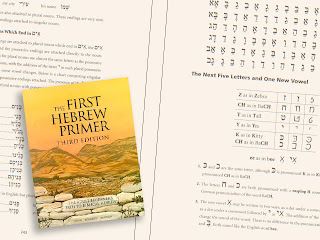 |
| The First Hebrew Primer: The Adult Beginner's Path to Biblical Hebrew, Third Edition |
It's hard to believe that 18 years ago on this very day I was honorably discharged from the Army. I will never forget this date because finishing my tour with the Army was a huge, huge milestone in my life. I had proven to myself that I had staying power and that I could actually accomplish what I had set my mind to do. One month after I was out, I started working towards a degree in graphic design at the Art Institute of Dallas. After college I had a fulfilling 11-year stint in the design industry. Now, close to two decades after leaving the Armed Forces, I have enrolled in a 3-year, online, Messianic, Torah school. My ultimate goal in taking this course is to learn how to handle the Text correctly, so I can study It properly and teach It more accurately. One of the values of our fledgeling community is the proper handling of the Scriptures and going through this TRI program is my contribution. Because I am married at 40 years old with six children and a full-time job, it will be a challenge to find the time to study. But, this will only be one more test of my resolve and this time, I've got Adonai pulling for me and I've got the help of His Ruach.
~
Jun 19, 2011
And Sought To Put Him To Death
 |
| The Brit Milah of Moses Michael Gonzales took place on the eighth-day, 16th of Sivan, 5771 which corresponds to Saturday, June 18, 2011 |
A week before my son was born I had a dream about his circumcision. In the dream we were at our church building celebrating with our entire community before the ceremony when I realized I had not yet told the mohel about my son's birth. It was only a couple of minutes before we were to begin the Brit Milah (Covenant of Circumcision) liturgy and the mohel was not there. He lives in Fort Collins, which is at least an hour away, and at this point I wasn't even sure if he was available to make it. My gut was filled with anxiety as I looked out my bedroom window, beating my fist on the window seal wondering what to do (don't ask me how I got to my bedroom—it's a dream!). I thought, "How could I, a leader in our community, be so negligent and miss this important detail?" I woke up convinced that this dream was true. I was still beating myself up and my gut was filled with nervousness. It all seemed so real. I turned to my wife, put my hand under the covers, reached out and felt her belly. Ah, relief. She was still pregnant. It was only a dream. The anxiety left but the thoughts remained.
The Covenant of Circumcision is one of those appointed times that doesn't give you a lot of time to plan—only eight days. We knew we were having a boy so we knew we would be needing the services of a mohel. We contacted a mohel one month prior and made him aware of our son's expected due date and the fact that Margaret usually gives birth two-weeks early. Our son was actually born four days after the due date which really through us all for a loop (see: In Uncharted Territory). A few hours after the birth I contacted the mohel to tell him the news and found out that he was going to be out of town on the eighth-day. I felt anxiety starting to develop deep in my gut.
On top of the short notice after the birth of a son, what makes it even trickier when planning for a circumcision is when the eighth-day falls on Shabbat (Sabbath) or a Moed (Feast Day). In our case it fell on Shabbat. That's why you should always have a 'Plan B' in case the mohel is not available or something goes wrong with the logistics. My fallback plan was to have a local pediatrician perform the circumcision; however, this plan only works Monday thru Friday during normal business hours. The anxiety began to intensify.
It is the responsibility of the father to make sure that his infant son is circumcised—that would be me. Also, the elders are to live exemplary lives for their community to follow—that would also be me. You could say that I had a lot riding on my shoulders at this point and it was feeling like a ton of bricks. I had recently announced to the community that everyone would be invited to the ceremony and once I found out that the ceremony fell on Shabbat, I knew that there would be a good turnout of members. My concern was that my dream was coming true. I did not have a mohel lined up yet and everyone was going to show up and see that I was not prepared. Huh-boy. I was now feeling the same anxiety that I did after the dream.
I don't want to come across legalistic about the situation, but I believe that circumcision is important—important to Adonai. If we desire to follow the Torah, then we should do whatever we can to perform the circumcision of our infant boys at the appointed time. The ordeal I was in brought to mind the incident in Exodus 4:24-26 concerning Moses and his wife Zipporah. This is an odd passage about the circumcision of Moses's son that has drawn much attention and debate. The popular explanation of this passage is that Moses—the appointed leader of his people, the representative of Adonai, and the person chosen to deliver the Torah to Israel—had procrastinated and neglected to circumcise his own son. Because of this, Adonai came down and "sought to put him to death." Now, I don't think that my life, or anyone's life for that matter, would be in danger if the circumcision of an infant son is neglected. But the fact that I am the leader of my home, a leader in a Torah-Community and I am a teacher of the Torah means that I will someday have to answer for my negligence and my bad example. I would never make anyone feel guilty about not circumcising their sons or doing it on the 'wrong' day, but I will strongly recommend to the families in our community to try as hard as they can to do it and do it on the eighth-day.
Through the providence of Adonai, after a couple of days of butterflies in my stomach, I was reconnected with the mohel who circumcised my second son, Aaron, on Yom Kippur 5767 (2006). I confirmed the date and scheduled the ceremony. The community was there and everything went off without a hitch. My third son, Moses, was circumcised on the eighth-day as commanded. Baruch HaShem! After all of that I have now come to realize that the circumcision was the easy part; now comes the commitment and diligence in bringing him up in the discipline and instruction of Adonai (Ephesians 6:4).
~
Jun 1, 2011
Jews, Messianics and Christians—Where's the Unity?
Below are some thoughts, observations and opinions about unity within the Greater Body of Messiah.
It is no surprise that Messianics are in a unique situation. They can be found in the middle of the Rabbinic Jewish and Protestant Christian faiths. They identify with Rabbinic Jews because they believe that the Torah, the Law of God, is relevant for believers today while simultaneously identifying with Christians; because they believe that Yeshua (Jesus) is Messiah. Many Messianics have come out of Christianity to return to the Hebraic Roots of their faith. Some find that now they identify more with Rabbinic Jews than they do with their Christian brothers. They become enamored with the traditions of the Orthodox Rabbinic Jews and usually embrace an American-Ashkenazi expression of worship. It seems that these Messianics relate to those who 'do' what they do more than those who 'believe' what they believe. To an extent, this thinking is correct because in Hebraic thought 'doing' and 'believing' are inseparable. But their desire to adopt Rabbinic traditions has no merit in the Rabbinic Jewish community.
The Children of Israel were called to be a light to the nations, but Rabbinic Jews have made little effort to reach out to non-Jews with the truth of the Torah. This is why, in the diagram above, there are no arrows coming out of the brown circle representing Rabbinic Judaism. The green circle represents Protestant Christianity while the blue circle represents the modern Messianic Community.
Below is an explanation of the arrows in the diagram which represent relationships between these faiths.
 |
| Diagram 1 – Faith Overlap |
It is no surprise that Messianics are in a unique situation. They can be found in the middle of the Rabbinic Jewish and Protestant Christian faiths. They identify with Rabbinic Jews because they believe that the Torah, the Law of God, is relevant for believers today while simultaneously identifying with Christians; because they believe that Yeshua (Jesus) is Messiah. Many Messianics have come out of Christianity to return to the Hebraic Roots of their faith. Some find that now they identify more with Rabbinic Jews than they do with their Christian brothers. They become enamored with the traditions of the Orthodox Rabbinic Jews and usually embrace an American-Ashkenazi expression of worship. It seems that these Messianics relate to those who 'do' what they do more than those who 'believe' what they believe. To an extent, this thinking is correct because in Hebraic thought 'doing' and 'believing' are inseparable. But their desire to adopt Rabbinic traditions has no merit in the Rabbinic Jewish community.
 |
| Diagram 2 – Faith Relationships |
The Children of Israel were called to be a light to the nations, but Rabbinic Jews have made little effort to reach out to non-Jews with the truth of the Torah. This is why, in the diagram above, there are no arrows coming out of the brown circle representing Rabbinic Judaism. The green circle represents Protestant Christianity while the blue circle represents the modern Messianic Community.
Below is an explanation of the arrows in the diagram which represent relationships between these faiths.
- Welcome: Rabbinic Jews are willing to associate with Christians in select venues because they see Christianity as a separate and distinctly different faith. The Jews have the Old Testament and the Christians have the New Testament. The Jews have Adonai and the Christians have Jesus. But today, more Christians are realizing the importance of Israel and the Jewish people in relation to the return of Jesus. The result is an abundance of Christian groups who support Israel. Without a doubt, the Jewish people are grateful for this support but by and large, this effort to 'reach out' is not reciprocal.
- Welcome: Christians are more accepting (or at least tolerant) of Messianics than Messianics are of Christians. This is an observation. I'm not saying that all Christians are lovey-dovey over Messianics. In fact some Christian leaders consider Messianics legalists or Judaizers. I am referring to personal, one-on-one relationships. Again, these are my observations and experiences. When we started The Front Range Messianic Community we met some Christians who supported us until we got on our feet. They never had anything negative to say about our Messianic beliefs. Since then, some of the most influential people that we've met have been Christians. They've inspired us and helped us and none of them have looked down on us because of our Messianic faith and practices. They may not totally agree with us but they haven't belittled or berated us either. We have a connection with them through Yeshua and His Ruach.
- Not Welcome: Messianics are not welcome in the Rabbinic Jewish Community--period. Messianics who think otherwise are mistaken. The Jews for Judaism article Is The Christian Movement Called "Messianic Judaism" a Form of Judaism? can shine some light on how Rabbinic Jews view Messianics, Jewish and non-Jewish. I don't blame Rabbinic Jews for the way they feel about us. I'm not mad at them for not accepting us or our Messiah. On the contrary, I pray for them and Israel. They are God's people whom He loves.
- Not Welcome: I have seen some Messianics act hostile toward Christians. I'm not talking about all Messianics, but I know some who have ill feelings toward Christians. When the word Christian is mentioned, their face puckers at the thought of these Greek-minded pagan idolaters. I have to admit, I was like this early on in my walk in Torah. I was ready to bash any Sunday-keeper who crossed my path. But then I was reminded of the mercy and grace that my Savior extended to me when I was a pork-eating, Sunday-keeping Roman Catholic. I saw how I was not extending to my Christian brothers the same love and patience that Messiah extended to me. Christians are taught Christian doctrine; it's what they know and believe. Bashing them with the Torah isn't going to make them desire it. It will only repel them. It is a shame to see folks who have been walking in Torah for many years continue to disassociate with Christian brothers because they do not 'do' what we 'do'. Messianics have more in common with Christians than they do with Rabbinic Jews. We have Yeshua and His Ruach. Besides, Christians follow the Torah more than they realize and more than Messianics give them credit for. Regarding the Body of Messiah, Paul said:
"Always be humble, gentle and patient, bearing with one another in love, and making every effort to preserve the unity the Spirit gives through the binding power of shalom."
- Ephesians 4:2,3 CJB
Finally, what about unity within the Greater Messianic Community? Is this even possible? The Messianic Community has so many variations today, can we find a common ground to agree upon?
~
Subscribe to:
Posts (Atom)